On this page
Educational only, not medical advice. It can't diagnose or treat any condition. If you have a heart, joint or other health condition, check with your doctor before starting a new exercise, diet or supplement.
The takeaway
If you read nothing else, read this.
- Push-ups, a one-leg stand, chair stands, resting heart rate and sleep consistency are all quick to check at home.
- Each is tied in research to long-term health, but none is a diagnosis.
- Retest every 8 to 12 weeks and watch the direction, not one number.
Most of what predicts how well you'll age isn't sold in a bottle. Some of the strongest signals in the research are things you can check in your living room in ten minutes. Want to know where you actually stand?
1. Push-ups
In a study of 1,104 active male firefighters followed for 10 years, men who could do more than 40 push-ups had a far lower rate of cardiovascular disease events than men who managed fewer than 10. The researchers found push-up capacity was more strongly associated with that risk than a submaximal treadmill test.
How to test: do as many good-form push-ups as you can without stopping. Knees or an incline are fine as a starting point; note which you used.
The limit: the study only included middle-aged, active men, so the numbers may not carry over to women or less active people.
2. The 10-second one-leg stand
In a 2022 study of adults aged 51 to 75, people who couldn't stand on one leg for 10 seconds without support had nearly double the risk of death from any cause over the following decade.
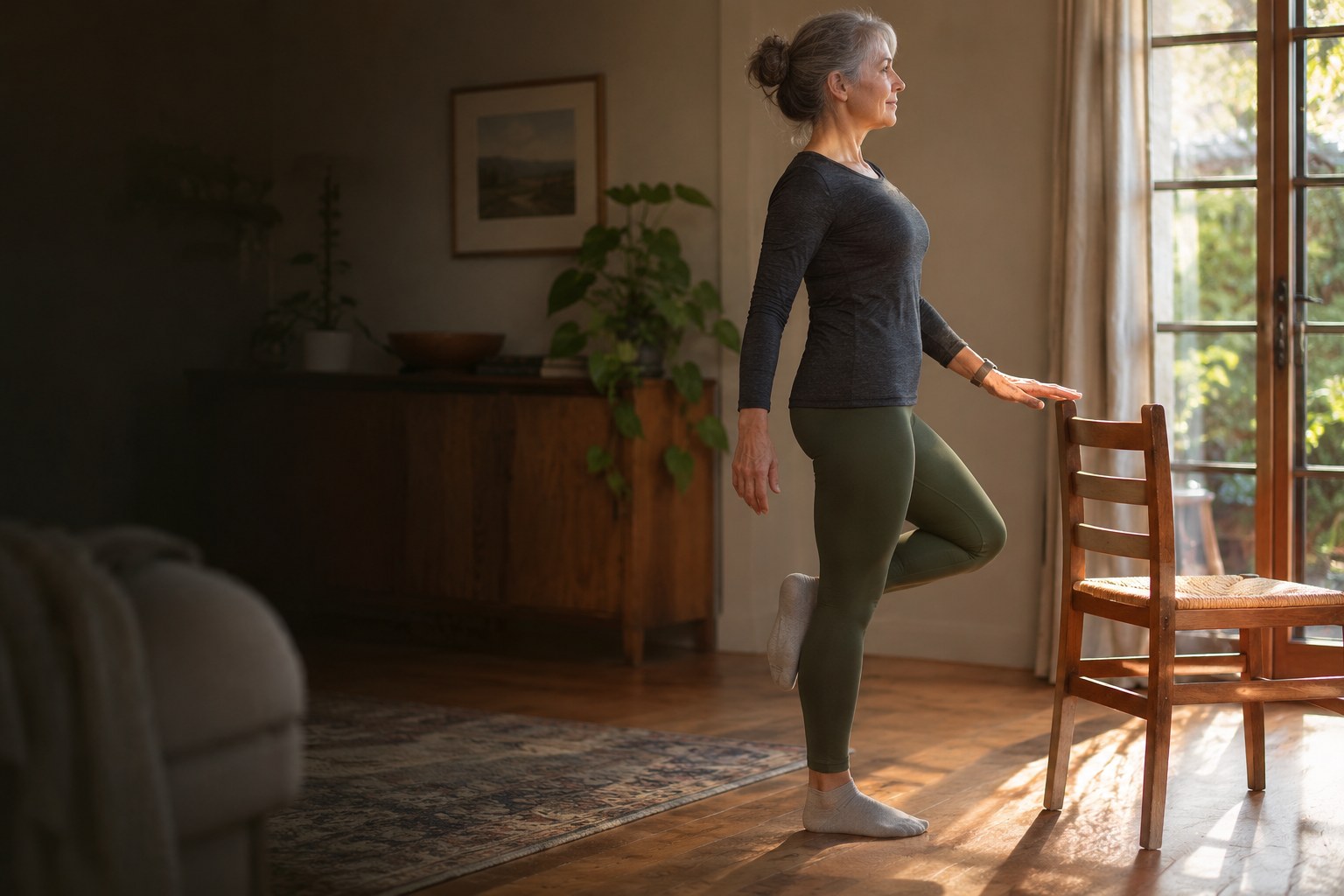
How to test: stand near a counter, lift one foot and rest it behind the opposite calf, arms at your sides. Try each leg. Keep a hand ready to catch yourself.
3. The 30-second chair stand
The CDC uses this in its falls screening for older adults. Sit in the middle of a chair without armrests, cross your arms over your chest, and count how many times you can stand fully and sit back down in 30 seconds. For adults 60 and over, the CDC lists below-average cutoffs by age; for example, under 14 stands for men and under 12 for women aged 60 to 64 suggests a higher fall risk.
4. Resting heart rate
A meta-analysis of 46 studies covering more than 1.2 million people found that each 10-beat-per-minute rise in resting heart rate was associated with about a 9% higher risk of death from any cause. People with resting rates above 80 had about 45% higher risk than those in the lowest group.
How to test: before getting out of bed, count your pulse for a full 60 seconds. Do it three mornings and average them.
5. Sleep consistency
In a study of more than 60,000 adults wearing activity trackers, people with more regular sleep-wake times had a 20 to 48% lower risk of dying from any cause, and regularity predicted that risk better than sleep duration. Our sleep guide covers how to fix this one.
Put it together
Any single test is a snapshot. Together they show a pattern: strength, balance, cardiovascular fitness and recovery. That's exactly what the free Foundry Score does. It takes these markers plus protein and weekly cardio, gives you a score out of 100, and tells you the three moves that will help you most.
How we graded it
We gave this guide a B. Every test is backed by published research, but most of the studies are observational and some cover narrow groups. Use these to track your own direction over time, not to diagnose anything. If a result worries you, take it to your doctor.
Where the experts stand
- Peter Attia's "Centenarian Decathlon" is a personal list of physical tasks to still manage in your final decade, such as getting up off the floor using at most one arm for support. Stanford Lifestyle Medicine
- Attia calls VO2 max, a measure of cardio fitness, one of the strongest predictors of longevity. A treadmill study of 122,007 adults points the same way: higher fitness, lower risk of death. CBS 60 Minutes
Our grade comes from the research above, not from any one expert. Citing them doesn’t mean they reviewed or endorse Vitality Foundry. The experts we follow.
Sources
- 1Yang et al., JAMA Network Open, 2019: Push-up capacity and cardiovascular events
- 2Araújo et al., British Journal of Sports Medicine, 2022: 10-second one-legged stance and survival
- 3CDC STEADI: 30-Second Chair Stand Test
- 4Zhang et al., CMAJ, 2016: Resting heart rate and mortality meta-analysis
- 5Windred et al., SLEEP, 2024: Sleep regularity and mortality
How the grade works: our standards.